Tuesday, April 7, 2015

A Day Will Come

A Day Will Come by Julie Hebert 

A day will come in every life,
When appreciation is rendered.
And this should be taken seriously
And given with love and tender.

Anyone who deserves appreciation,
Must have done something great.
So share with them the way you feel,
And always treat them right.

But keep in mind that appreciation,
Should be given again and again.
If you truly appreciate,
You'll remind them how great they've been.

Do something special to thank the ones,
Who've made a difference to you.
But don't forget to thank them again,
For everything they do. 


More reading:
  • http://www.wow4u.com/aboutjuliehebert/index.html
  • http://www.stresslesscountry.com/juliehebert/index.html


"I Had a Hippopotamus" by Patrick Barrington

I had a Hippopotamus, I kept him in a shed
And fed him upon vitamins and vegetable bread
I made him my companion on many cheery walks
And had his portrait done by a celebrity in chalk

His charming eccentricities were known on every side
The creatures' popularity was wonderfully wide
He frolocked with the Rector in a dozen friendly tussles
Who could not but remark on his hippopotamuscles

If he should be affected by depression or the dumps
By hippopotameasles or the hippopotamumps
I never knew a particle of peace 'till it was plain
He was hippopotamasticating properly again

I had a Hippopotamus, I loved him as a friend
But beautiful relationships are bound to have an end
Time takes alas! our joys from us and rids us of our blisses
My hippopotamus turned out to be a hippopotamisses

My house keeper regarded him with jaundice in her eye
She did not want a colony of hippotami
She borrowed a machine gun from from her soldier nephew, Percy
And showed my hippopotamus no hippopotamercy

My house now lacks that glamour that the charming creature gave
The garage where I kept him is now as silent as the grave
No longer he displays among the motor tyres and spanners
His hippopomastery of hippopotamanners

No longer now he gambols in the orchards in the spring
No longer do I lead him through the village on a string
No longer in the morning does the neighbourhood rejoice
To his hippopotamusically-modulated voice.

I had a hippopotamus but nothing upon earth
Is constant in its happines or lasting in its mirth
No joy that life can give me can be strong enough to smother
My sorrow for that might-have-been-a-hippopota-mother


Links:
Another good one of Barrington's: http://wonderingminstrels.blogspot.com/2002/04/diplomatic-platypus-patrick-barrington.html

Limited biography: http://en.wikipedia.org/wiki/Patrick_Barrington,_11th_Viscount_Barrington

More by Barrington: http://allpoetry.com/Patrick-Barrington

Photo courtesy of: http://buzzerg.com/311252-hippopotamus-leaving-the-water-id-160393.htm

William Carlos Williams

This Is Just To Say

William Carlos Williams 

I have eaten
the plums
that were in
the icebox
and which
you were probably
saving
for breakfast

Forgive me
they were delicious
so sweet
and so cold

Further Readings:
http://www.poets.org/poetsorg/poet/william-carlos-williams
http://www.poetryfoundation.org/bio/william-carlos-williams

Eugene Field


Here is a poem I love:
Image result for fly fishing


Our Biggest Fish Poem
By: Eugene Field

When in the halcyon days of old, I was a little tyke,
I used to fish in pickerel ponds for minnows and the like;
And oh, the bitter sadness with which my soul was fraught
When I rambled home at nightfall with the puny string I'd caught!
And, oh, the indignation and the valor I'd display
When I claimed that all the biggest fish I'd caught had got away!

Sometimes it was the rusty hooks, sometimes the fragile lines,
And many times the treacherous reeds would foil my just designs;
But whether hooks or lines or reeds were actually to blame,
I kept right on at losing all the monsters just the same--
I never lost a little fish--yes, I am free to say
It always was the biggest fish I caught that got away.

And so it was, when later on, I felt ambition pass
From callow minnow joys to nobler greed for pike and bass;
I found it quite convenient, when the beauties wouldn't bite
And I returned all bootless from the watery chase at night,
To feign a cheery aspect and recount in accents gay
How the biggest fish that I had caught had somehow got away.

And really, fish look bigger than they are before they are before they're
caught--
When the pole is bent into a bow and the slender line is taut,
When a fellow feels his heart rise up like a doughnut in his throat
And he lunges in a frenzy up and down the leaky boat!
Oh, you who've been a-fishing will indorse me when I say
That it always is the biggest fish you catch that gets away!

'T 'is even so in other things--yes, in our greedy eyes
The biggest boon is some elusive, never-captured prize;
We angle for the honors and the sweets of human life--
Like fishermen we brave the seas that roll in endless strife;

And then at last, when all is done and we are spent and gray,
We own the biggest fish we've caught are those that got away.

I would not have it otherwise; 't is better there should be
Much bigger fish than I have caught a-swimming in the sea;
For now some worthier one than I may angle for that game--
May by his arts entice, entrap, and comprehend the same;
Which, having done, perchance he'll bless the man who's proud to say
That the biggest fish he ever caught were those that got away.

Eugene Field
Submitted: Thursday, January 1, 2004


Further Reading


Strange Fruit by Abel Meeropol

Strange Fruit

by Abel Meeropol


Southern trees bear a strange fruit,
Blood on the leaves and blood at the root,
Black body swinging in the Southern breeze,
Strange fruit hanging from the poplar trees.

Pastoral scene of the gallant South,
The bulging eyes and the twisted mouth,
Scent of magnolia sweet and fresh,
And the sudden smell of burning flesh!

Here is a fruit for the crows to pluck,
For the rain to gather, for the wind to suck,
For the sun to rot, for a tree to drop,
Here is a strange and bitter crop.

More about the author:http://www.npr.org/2012/09/05/158933012/the-strange-story-of-the-man-behind-strange-fruitMore about the poem:https://www.wsws.org/en/articles/2002/02/frut-f08.htmlAlso:Watch Billie Holiday Perform 'Strange Fruit'!


Still Life- Carl Sandburg

Still Life

Cool your heels on the rail of an observation car.
Let the engineer open her up for ninety miles an hour.
Take in the prairie right and left, rolling land and new hay crops,
      swaths of new hay laid in the sun.
A gray village flecks by and the horses hitched in front of the
      post-office never blink an eye.
A barnyard and fifteen Holstein cows, dabs of white on a black
      wall map, never blink an eye.
A signalman in a tower, the outpost of Kansas City, keeps his
      place at a window with the serenity of a bronze statue on a
      dark night when lovers pass whispering.


Further information on Carl Sandburg:


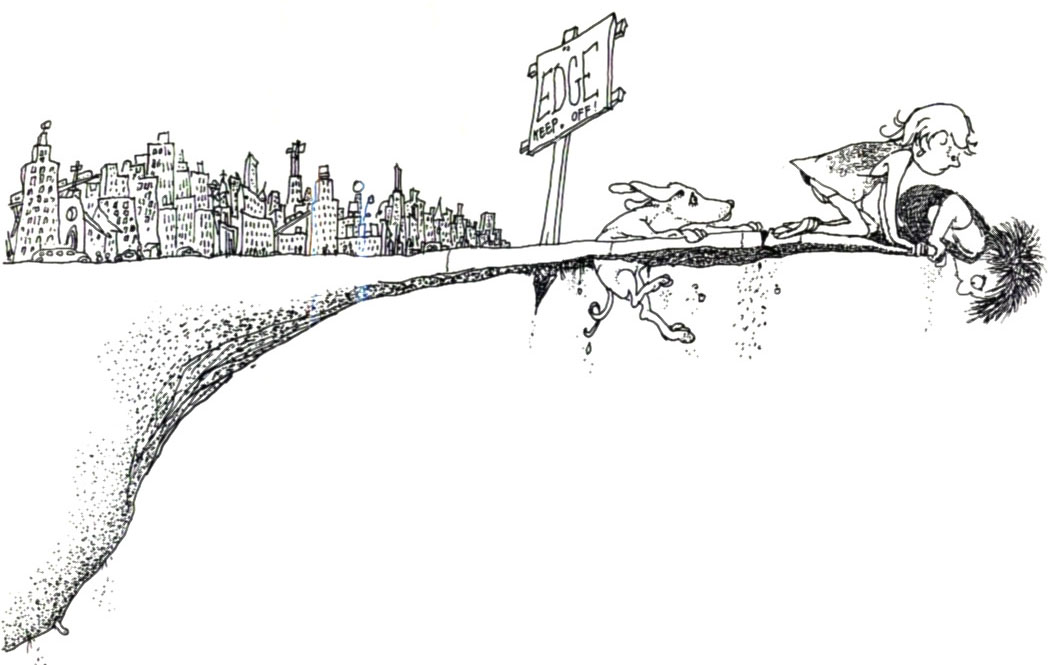
"Where the Sidewalk Ends"

Where the Sidewalk Ends
By Shel Silverstein

Photo courtesy of http://www.projectrisemusic.com/system/files/music/387652854_wherethesidewalkends-copy.jpg

There is a place where the sidewalk ends
And before the street begins,
And there the grass grows soft and white,
And there the sun burns crimson bright,
And there the moon-bird rests from his flight
To cool in the peppermint wind.

Let us leave this place where the smoke blows black
And the dark street winds and bends.
Past the pits where the asphalt flowers grow
We shall walk with a walk that is measured and slow,
And watch where the chalk-white arrows go
To the place where the sidewalk ends.

Yes we'll walk with a walk that is measured and slow,
And we'll go where the chalk-white arrows go,
For the children, they mark, and the children, they know
The place where the sidewalk ends

About the author:
http://www.shelsilverstein.com/

Video of the poem:
http://www.poemhunter.com/poem/where-the-sidewalk-ends-4/